




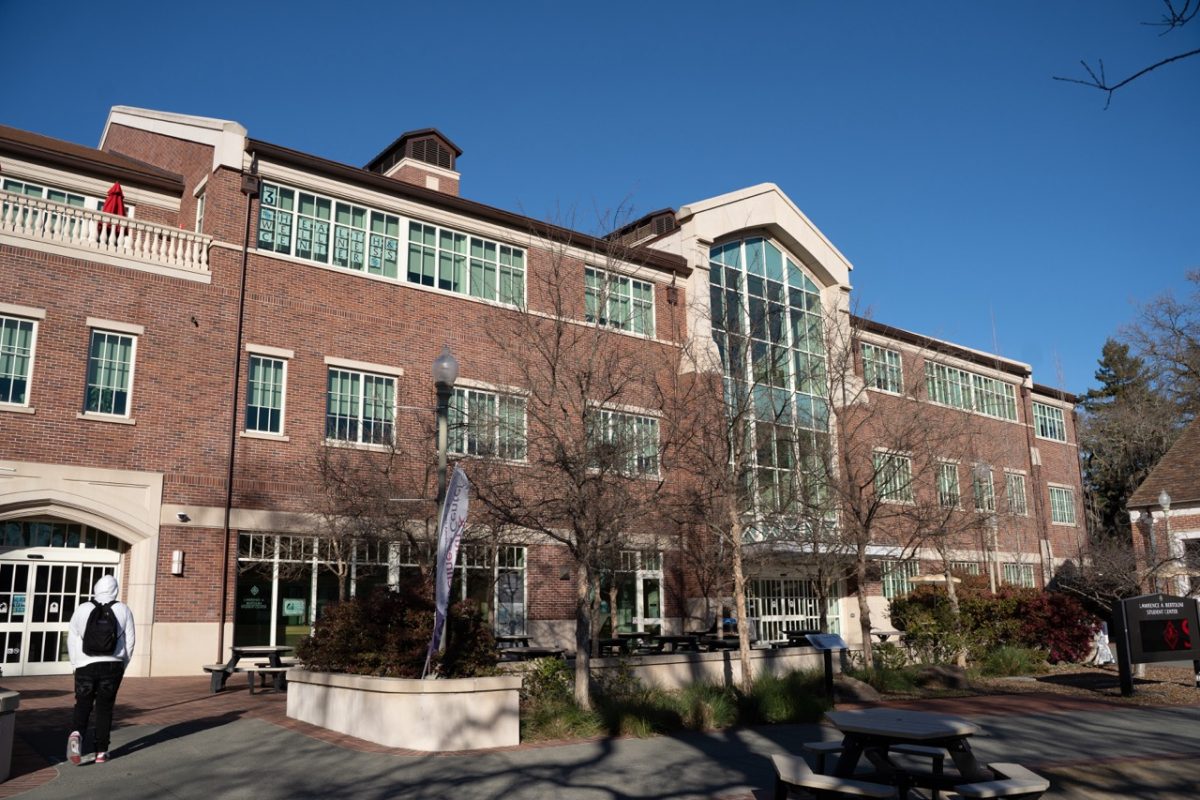
Santa Rosa Junior College trustees reviewed a $830 million bond proposal for the November 2026 ballot and an enrollment plan that shows a decline, while hearing public concerns about program changes at the SRJC Board of Trustees meeting May 12 in the Bertolini Student Center.
Vice President of Finance and Administrative Services Kate Jolley and Fairbank, Maslin, Maullin, Metz and Associates senior vice president Lucia Del Puppo presented updated polling results for the proposed general obligation bond measure.
Del Puppo reported strong voter support ahead of a potential ballot measure, standing at 60% “likely yes” and 29% opposed — above the 55% threshold needed for passage. Support has increased since the 2014 poll, which showed 56% backing, and “definite yes” responses also rose.
If approved, the measure would fund facilities modernization, workforce training spaces for nursing, emergency response and skilled trade programs in addition to infrastructure and technology upgrades across the district.
She added voters responded strongly to messaging focused on maintaining affordable higher education, expanding job training programs and addressing building maintenance, particularly paired with assurances that the measure wouldn’t increase the current tax rate in Sonoma County.
Del Puppo said these poll findings will support the upcoming discussion at the Board’s special meeting May 21 on moving forward with the installation of the bond measure on the November 2026 ballot.
“We think that with continued education and communication with the community on the importance of this measure, it should be well-positioned for November,” Del Puppo said.
Robert Holcomb, vice president of academic affairs, and Molly Senecal, vice president of student services, presented the Strategic Enrollment Management Plan that included enrollment trends and projections, SEMP implementation workgroup, a three-part SEM series management team and a timeline for the updated plan.
Holcomb reported that full-time equivalent student enrollment dropped from over 17,500 before the pandemic to roughly 12,500 during the pandemic. Although enrollment increased by 600 FTEs annually in recent years, fall 2026 growth only reached 2.8%, below the district’s projected 5% to 6%.
Holcomb said the district is shifting from a recruitment-focused strategy toward a retention-focused approach aimed at improving student persistence, course availability and completion rates.
The presentation also highlighted expanded dual enrollment partnerships, shorter eight-week course pathway models and increased student support services in support of the district’s retention efforts.
Board trustee Ezrah Chaaban raised questions on geographic equity, particularly in East County, Sonoma Valley and other rural communities, where transportation and campus access remain barriers for students.
“I want the college to be intentional about how we are doing [transportation], especially for communities that don’t have a campus, because people are facing intergenerational poverty, language barrier access issues and couldn’t use the services our college provides,” Trustee Chaaban said. “That is a top priority to me.”
Adjunct instructor Joel Newberg spoke on behalf of the Fire Union, raising concerns about lifelong learning course sections and delayed class offerings. He argued these changes could negatively affect instructors and older learners who rely on the program.

“The lifelong learning program is a lifeline for many of our students suffering a sense of community; it offers a sense of community as well as intellectual enrichment,” Newberg said.
Newberg said the district shared the growth of the program, onboarding of eight new instructors and the support for the program’s future, then later unilaterally cut 10 sections and pushed back the start of classes due to the misallocation of FTEs without any warning.
“We understand that SRJC has a substantial budget shortfall; however, we ask the district to work with SRJC AFD and not unilaterally decide to impact the lifelong program, students and instructors in the future,” he said.
Newberg added that the district didn’t provide any background information on the decision until May 5, and has concerns for students who may have expected to enroll in these canceled courses.
SRJC President Dr. Angélica Garcia responded to these concerns in her president’s report, saying that scheduling decisions were made collaboratively between administrators and department chairs based on enrollment and allocation needs. She also said that misinformation circulating in the community has contributed to confusion about the program’s future.
“SRJC continues to serve its mission, which includes supporting all of our students in the lifelong learning program,” Dr. Garcia said.
Previous dance student, Jordan Tauzer-Pardo, and her mom, Janelle Tauzer-Pardo, returned to the board, thanking the district, human resources officials and the board for taking action after what they described as multiple grievances filed over two years stemming from allegations of abuse, misconduct and retaliation involving former dance instructor, Cassandra Hillman.
“That decision gives me a sense of validation and relief after a very long and difficult process,” Jordan Tauzer-Pardo said.
Janelle Tauzer-Pardo continued, “When the college demonstrates that standards apply to everyone, it strengthens confidence in this institution and shows students that their voices and experiences matter.”
The accused former dance instructor, Cassandra Hillman, recently resigned from her position following the allegations raised by former dance students and faculty, after a lengthy absence from campus.
Outgoing student trustee Kaya Clark delivered her farewell report reflecting her year in office and acknowledging both the challenges and rewards of student governance. Clark spoke about experiencing student burnout, leadership pressures and the emotional demands of student governance.
“Being a student trustee reinforced the importance of showing up in person rather than not showing up at all, staying curious, and above all, embracing agency, the ability to make decisions independently and the ability to transform knowledge into actions so that it doesn’t stay silent,” Clark said.
She thanked her peers, advisors and administrators for their guidance while particularly highlighting mentor Trustee Maggie Fishman and Student Body President Diego Roman Hernandez for their support during difficult times. She also congratulated incoming student trustee Jason Reed, expressing confidence in his ability to represent and advocate for students.
Reed was sworn in as the new Student Trustee for the 2026-27 term, taking over for Clark. He emphasized collaboration, inclusion and advocacy for the student body.
“I am going to commit to this role as a student [who] is very committed to a collaborative spirit and inclusivity,” said Reed.
