



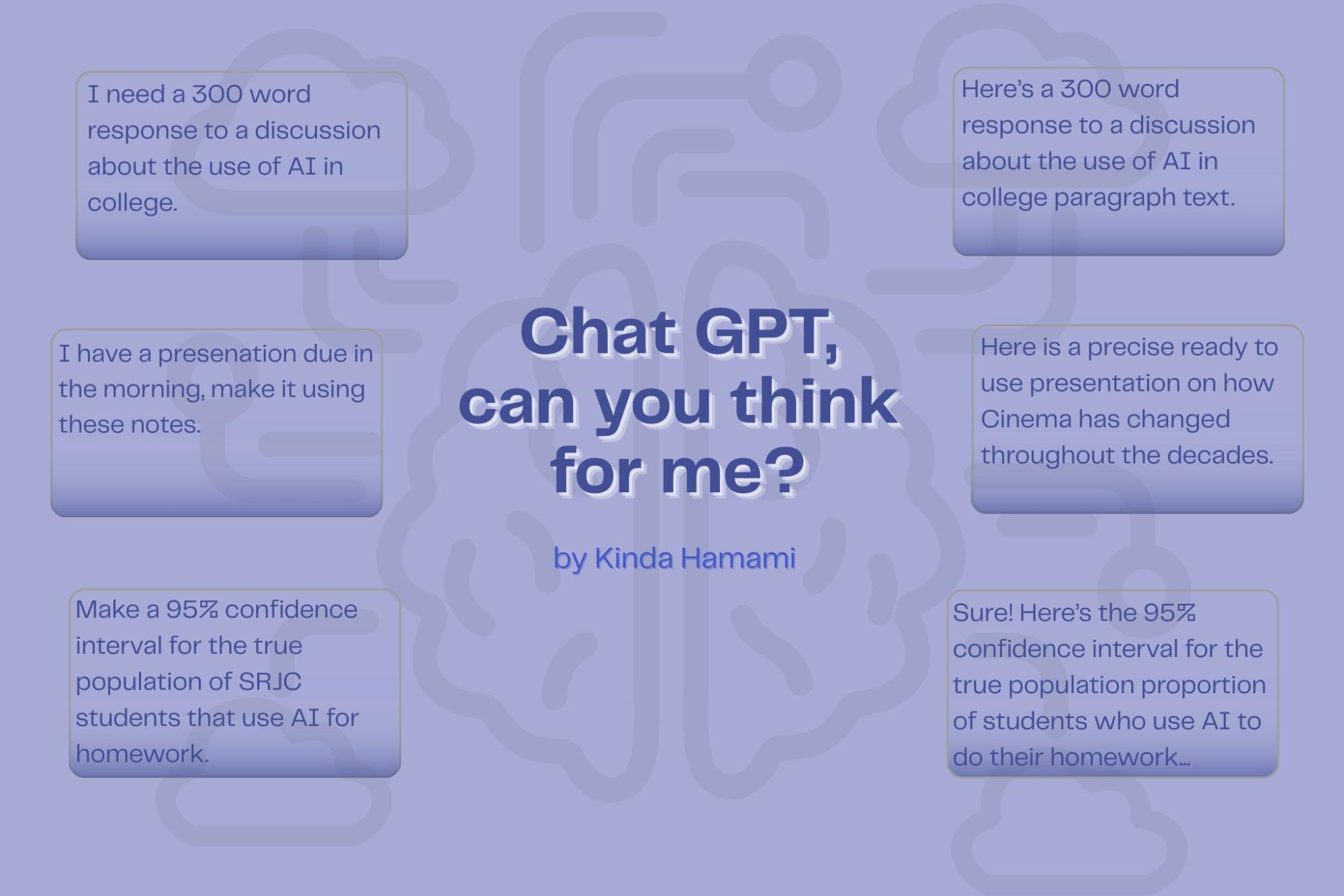
It was late at night and Santa Rosa Junior College first-semester nursing student Zara Knight had to give a presentation the next morning. She was tired and wanted an easy out, so she copied and pasted the instructions into ChatGPT. In less than a minute, the artificial intelligence chatbot spat out a ready-to-deliver presentation.
“It’s an easy out, and it’s not that I don’t know what I’m learning, because I do. I’m lazy; I don’t want to write the whole thing,” Knight said.
Another SRJC online-only student, who is majoring in human resources, said half the time she can’t understand the instructions provided. Instead of contacting her instructor or attending office hours, she relies on AI to decipher the assignment and tell her what to do. Then she uses her own brain to complete the work.
SRJC mechanical engineering student Miles Swarner, who created a ChatGPT account with its debut in 2022, logs onto the AI chatbot every day and asks it to do everything from analyze the class syllabus to point him to homework resources.
These three SRJC students are trying to navigate how to use AI in a college environment where rules vary from classroom to classroom and college policies have not kept up with ever-changing technology.
How SRJC students use AI
According to Copyleaks, nearly 90% of students have used AI for academic work in 2025, with 57% of students using AI to brainstorm, 44% using it to generate initial drafts and 28% to solve math problems.
When she’s struggling with her calculus homework, SRJC earth and space sciences student Aurora Stanton turns to AI.
“I use AI on certain homework assignments. It helps me understand to look at the steps that are placed out,” Stanton said.
SRJC student Darmielle Galicia uses AI to double-check her work. “I am also part of a child development class, so I look up other creative ideas I can incorporate into this curriculum,” Galicia said.
According to Emmanuel College, since the creation of ChatGPT, studies show 50-70% of college students have used the tool to cheat. Reports also show 70-80% of high school students use it to cheat as well.
An SRJC psychology student, who declined to give their name, refuses to use AI, fearing they won’t learn anything, and they dislike its ease of access.
“It takes away the thought process from students, and what makes them themselves,” they said. “Thinking’s a part of learning, and if something’s just given to you, then you’re not learning more about who you are and how you can navigate the world.”
Instructors’ policies vary
College instructors have varying policies when addressing AI. One SRJC instructor gives students a zero for assignments completed with AI. Another instructor directs students to develop their own AI policy for their class. With these varying policies come varying results to the AI issue.
San Francisco State University graduate teaching associate and English instructor Laird Harrison instructed his first-semester English students to propose their own AI policy and rules for the semester.
Harrison learned of this approach from a video by director and producer Antonio Bird.
Bird taught him an approach to academic integrity in which students state their individual values and then apply those values into the classroom. They, in turn, make an AI policy based on the previously discussed classroom values.
“On artificial intelligence, we said we will use it as a learning tool but not to copy text generated by AI into assignments,” Harrison said. “We will use it to brainstorm, but not actually write. We will use it to suggest synonyms but not whole sentences. Students who use AI to generate text for an assignment may lose as many as all the points for that assignment.”
Harrison said it’s important to note the different ways students can use AI, from correcting grammar and creating outlines to generating text for an assignment.
Other instructors, such as SRJC English instructor Jake Aharonian, have stricter AI policies that limit students’ use of AI. He restricts students from using AI to write their work, but is OK with them using it to find ideas or process information.
“If I suspect the use of AI or ChatGPT, I’ll run it through three different detector sites,” Aharonian said. “And if the average percentage of AI-generated content is 60% or higher, then it’ll be a failing grade on that essay.”
SRJC student Leslie Ixmata described two instructors with different AI policies and how those differing policies have impacted her learning.
“My English teacher, Matthew Martin, makes the policy with us at the beginning of the semester. We had a conversation with the class, and he gave us some background on plagiarism and AI. My ASL teacher, Joan Williams, doesn’t care, because you don’t actually need it in her class,” Ixmata said.
SRJC policies on AI
With the ever-growing rise of AI colleges are increasingly attempting to control students’ usage, and SRJC is no different. In the fall of 2025, SRJC launched its first Districtwide Generative AI (GenAI) Task Force, a year-long study to evaluate the role of AI across students’ learning.
“With representation from all constituency groups and students, the task force will provide districtwide guidance, identify professional development needs and recommend policies to ensure GenAI use at SRJC aligns with the college’s mission, values and commitment to equity and innovation,” said then-acting SRJC Public Information Officer Sarah Laggos.
The GenAI Task Force was formed in response to an Academic Senate recommendation and approved by the College Council.
The Academic Senate feared overuse of AI would stunt students’ critical thinking skills, and suggested that integration of AI should be discipline-based rather than generalized, according to the Nov. 5 Academic Senate meeting.
Robert Grandmaison, task force member and SRJC engineering and applied tech faculty, spoke of the committee’s contribution to SRJC and mentioned the beneficial use of AI in teachers’ lives as well.
“The Senate and other people in the district have established the need for us to come up with policy as regards the use of AI in the academic environment, not just from a student standpoint, but ways we might incorporate it into curriculum and the development of courses,” Grandmaison said.
He would like to use AI to develop a course outline for one of his classes and use AI to tackle time-consuming administrative tasks, such as writing letters to colleagues.
As AI use rises, and technology and policies surrounding it evolve, students like Knight and Swarner may have to curtail or change their AI use to fit the ever-changing classroom and college policies.
“I think it’s already changed,” Swarner said. “I’ve got an engineering professor who’s already asked me to declare whether I use AI on my assignments or not. It incentivizes me to think a little bit more in depth about the assignment and what I actually need to write.”
