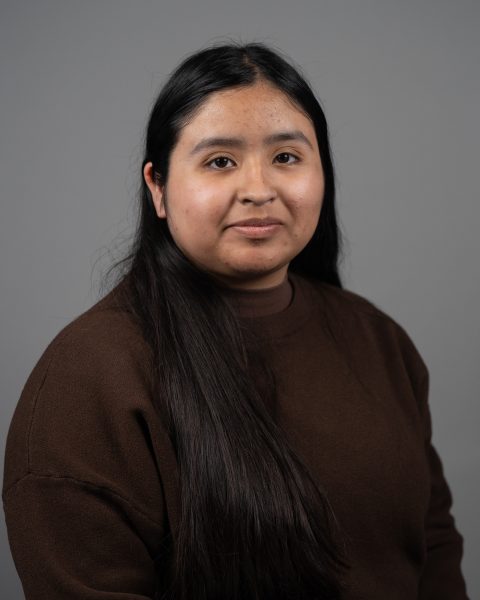

Dani Burlison, an SRJC adjunct faculty and author, recalls the time the North Bay Rapid Response Network (NBRRN) called on her to verify an alleged sighting of Immigration and Customs Enforcement (ICE) officers.
“It was really scary,” Burlison said. “I think it was DEA or something. It was a drug-related thing, and I was the only person that showed up. I ended up being able to identify them as not being ICE agents.”
Burlison has been an NBRRN legal observer and trainer for several years, beginning around the first Trump Administration when the North Bay Rapid Response Network was created.
Recently, Burlison went to an alleged ICE sighting in Rohnert Park with her partner. They saw 10 vehicles, 25 officers, bullet proof vests, guns and big dogs. However, it was Homeland Security, and they were not doing anything immigration related.
“We’re simply there to document, take videos, take photographs, document to help the community members that are getting detained,” Burlison said. “Legal observers also hand out red cards informing people on their rights in their court cases.”
Although Burlison thinks these encounters are scary and intimidating, she still heeds the call.
“It’s also important to show up and make sure the community is safe and that people know their rights and people are welcome.”
As of early 2026, ICE has held upwards of 73,000 detainees across detention centers nationwide amid increased funding and lenient arrest practices, resulting in a 2,450% increase in people without criminal records being detained.
In a time when the Trump administration’s immigration policies greatly affect immigrant communities, the NBRRN serves a critical role of alerting immigrants to ICE presence in the area, observing ICE officers and accompanying immigrants to hearings.
NBRRN is a network that trains people to serve as legal observers, dispatchers and accompaniment — additionally, the network also provides materials such as red cards.
The NBRRN helps people in Sonoma, Solano and Napa counties.
According to the U.S. Census Bureau, 16.8% of people living in Sonoma County are foreign-born.
NBRRN is part of the grassroots North Bay Organizing Project organization, which advocates for immigrant rights and other social issues.
“We actually don’t provide any direct services ourselves, but what we do is that we have community partnerships,” said Luis, a hotline coordinator for the NBRRN who requested only his first name be used. “So, we refer people to those partnerships that we have within each specific county.”
In addition to providing legal observer training and resources, the network also maintains social media accounts on Facebook and Instagram that alerts its followers about federal agent sightings. NBRRN helps debunk or confirm sightings once it is notified on a dedicated hotline. Confirmed sightings are blue while false alarms are green. Yellow means they are investigating. The social media pages also provide more context to the alleged sightings and explain the false alarms.
“We post on social media when we have confirmation, or direct confirmation, and that would mean that a family member or a close loved one called us and provided us information of a detainee,” Luis said. “If we don’t have that type of confirmation, we typically can’t post, because we don’t want to alarm the community, if we don’t have to, right?”
After receiving a message from dispatchers about a possible sighting, legal observers rush to the location to investigate. “My job then is to observe, not intervene, but simply observe,” said Daniela Kingwill, SRJC English for multilingual students faculty member and NBRRN legal observer for NBRRN.
Anyone can sign up for training.
NBRRN held a legal observer training in Santa Rosa on April 9; officials did not disclose the location for the training until the day prior for safety reasons. Even though people want to be involved and not be legal observers, they still go through training as it is “foundational to the work that we do,” according to Luis.
Kingwill has been a legal observer since 2017, during Trump’s first term. Although Kingwill received training in the past, she recently underwent refresher training.
“Back in the first Trump administration, you might open the door if you’re a legal citizen or a teacher in my case, and you might talk to them, you might try to reason with them and hold them off so that somebody else could maybe have a chance to get away,” Kingwill said. “Not anymore. Now, it’s more like if I’m a teacher in a classroom and I see ICE, I’m not talking to them. I’m probably gonna lock down my classroom and call Rapid Response.”“I’m not gonna be as willing to risk myself and talk to them because what I see going on out there is crazy. They’re insane. I mean, as far as what I’ve seen.”
Legal observers receive messages about federal agent sightings depending on where they live. Kingwill has not been able to respond to alerts due to her job as an EMLS instructor and location, since legal observers are notified based on proximity.
The network also trains dispatchers, who need to be bilingual, and accompaniment teams.
“The accompaniment team is a group of people that goes with people to their immigration appointments, and they basically just go with them in case there’s any enforcement during the appointments,” Luis said.
“The main focus of ours is to empower the community, and knowing that there’s allies and that there’s people that are also fighting for them, that the immigrant community is not alone.”