The ghost in the machine
To most, the word cybernetic conjures images of half-human robots like those in James Cameron’s cinematic masterpiece The Terminator, but when Arnold Schwarzenegger’s iconic character described himself as “a cybernetic organism” in the second film of the franchise, John Connor could just as truthfully have replied “twinsies.”
You see, “cybernetic” simply means “self-regulating.” Derived from the Ancient Greek nautical word kubernētēs, meaning “steersman” or “pilot,” the term cybernetics was coined in 1948 by mathematician Norbert Wiener in his book, Cybernetics: Or Control and Communication in the Animal and the Machine, to describe the study of systems that govern their own behavior.
Even beyond the overuse of its prefix to name anything related to computers — cyberwarfare, cybersecurity, or the once futuristic and now kitschy sounding concept of cybersex — the language of cybernetics permeates our everyday vernacular so commonly we don’t even see it. A cybernetic system regulates itself with a “feedback loop” informing corrections as needed. When those corrections succeed, the cybernetic system is said to have reached “equilibrium.”
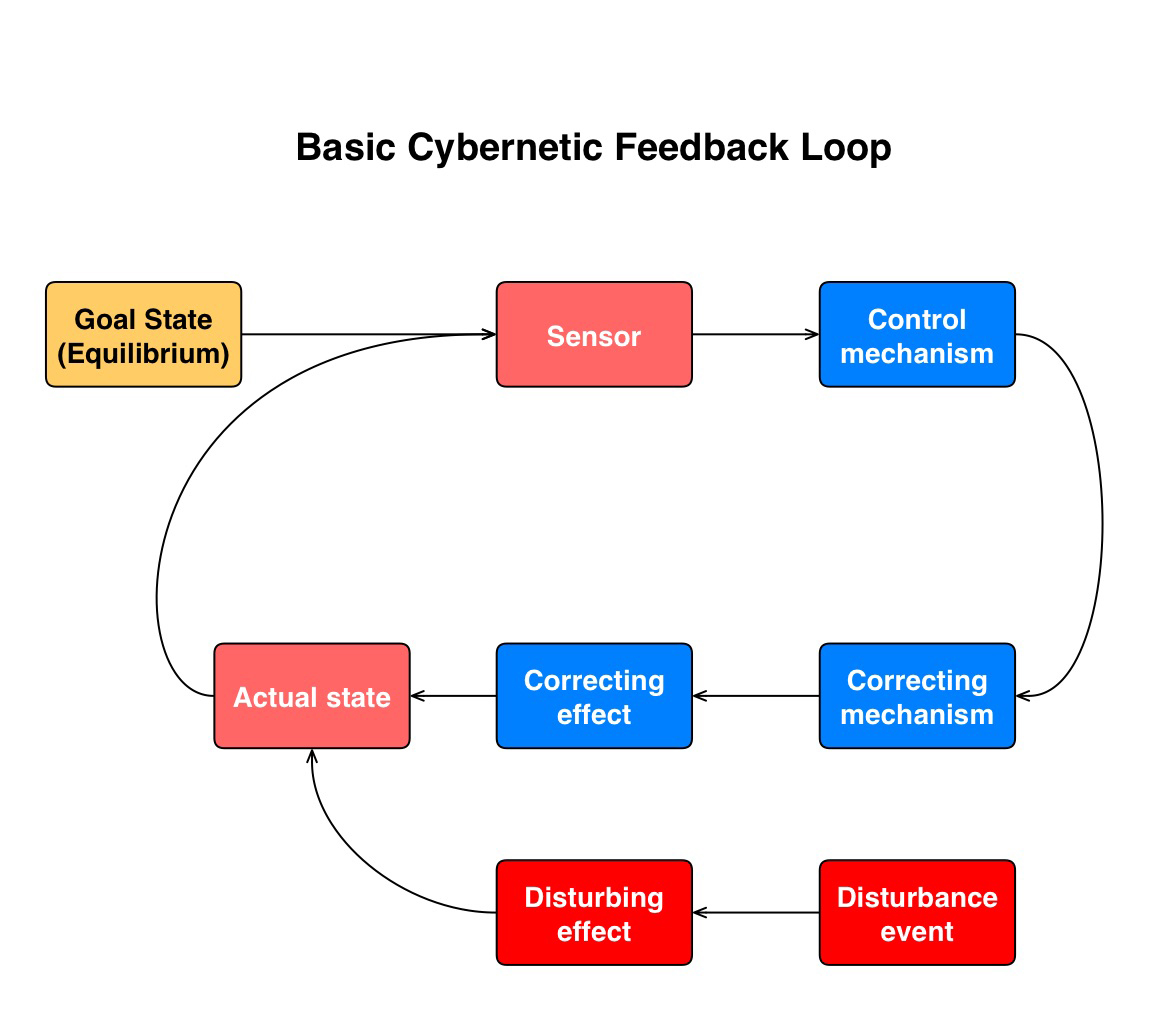
This vocabulary is familiar for good reason. Much of nature, particularly its living components, consists of nested cybernetic systems adapting at every scale, and human beings might be the most cybernetic of all.
So, when it comes to human systems as vast as an economy, we would do well to consider the cybernetic implications, lest we suffer equally colossal corrections.
Go with the flow
One of the simplest examples of manmade cybernetics lives in your very own bathroom. The water cistern behind your toilet maintains a consistent water level in the tank — its equilibrium. Too little, and your guest is left with an embarrassing problem when it comes time to flush. Too much and you’re replacing a floor or a ceiling, or both.
When the flush opens the outlet valve, water leaves the tank. The float drops. That drop provides feedback, signaling the system to open the inlet valve and refill from the water supply. As the water rises, so does the float. When it reaches its set level, the inlet closes. The feedback loop completes and equilibrium is restored.
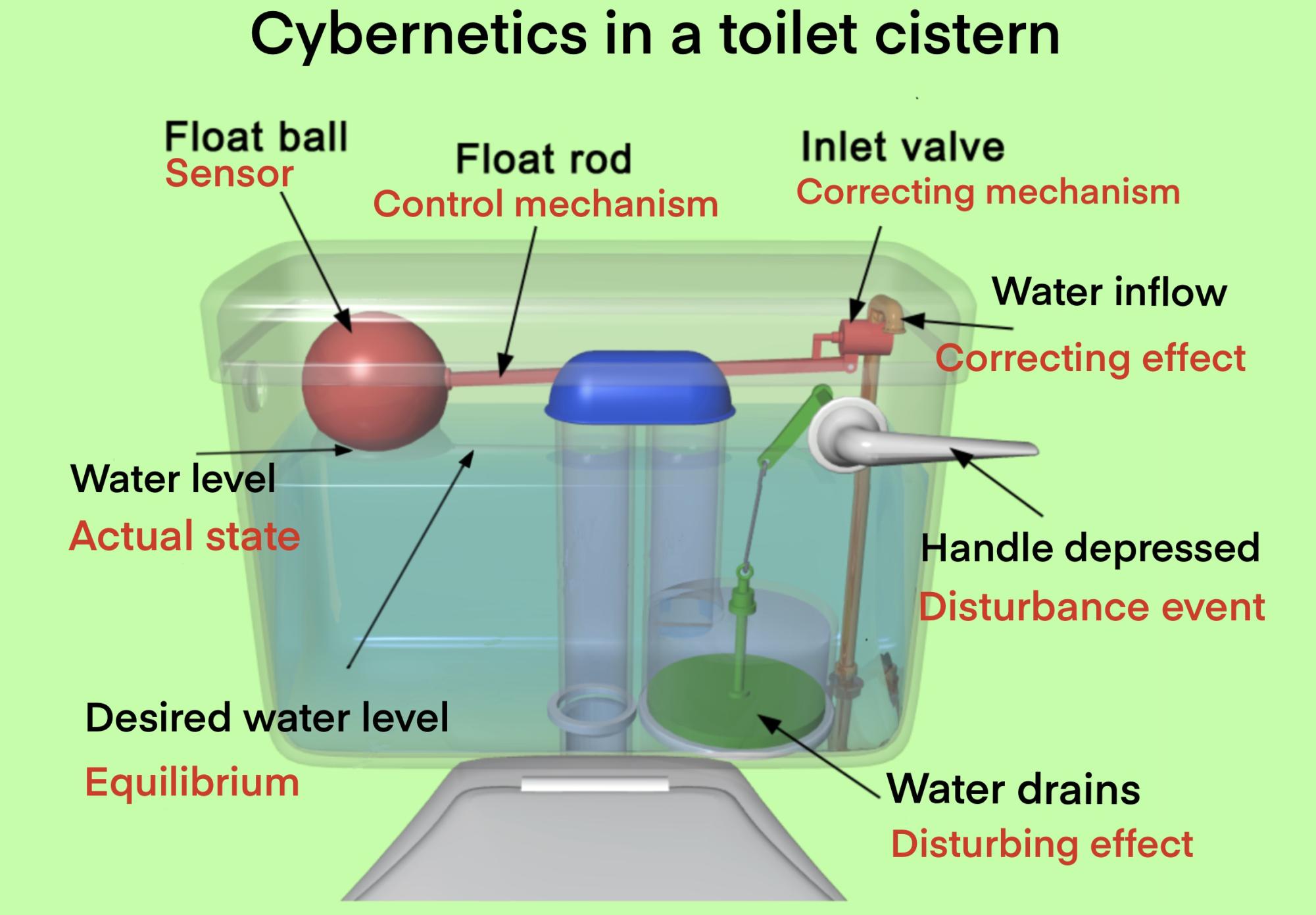
An underappreciated element of that system is the lid on top. The system must be what Wiener called “information tight” — its signals must reflect reality. Imagine your roommate stashes something in the tank, displacing water. The float still rises to the same level but there may not be enough water for a full flush. Perhaps the ziplock containing your shady roommate’s contraband obstructs the inlet valve so it can’t close and the tank overflows.
In both cases, the mechanism worked as designed. The fault lies with the extraneous information. When its feedback is distorted, the system doesn’t stop adapting; it adapts to the wrong signal. It misfires and destabilizes. And you have to make an awkward call to your landlord. The question is not whether our systems correct themselves. The question is what, or who, controls the signal they rely on.
No man is an island
No system exists in a vacuum. The cybernetic systems of our world are interwoven and interdependent, each nested within larger systems and shaped by those beneath them. What happens in one corner rarely stays there.
This is the essence of what mathematicians call a fractal — a pattern that repeats across scale. Fractals will be the subject of a future article, but suffice to say for now, these patterns shape our world, and distorting one can distort every other it touches.
Even our humble cistern sits at the center of a potential cascade extending far beyond the realm of the throne it serves. Maybe you lose your security deposit and have to find a new place to live. The downstairs neighbor has to replace their entire wardrobe through an insurance claim. Your landlord’s blood pressure spikes. A contractor gets a call.
Not all of the consequences are bad. Broken toilets feed plumbers’ families. A displaced tenant becomes a customer. Somewhere, someone has a good day. But these are ripples from a trivial failure. Scale the same pattern upward into markets, institutions and entire economies, and the balance shifts. The positive effects become incidental. The negative ones compound. What begins as a small distortion in one system does not remain small for long.
The world experienced this in the 2008 financial crisis. What began as distorted signals in a narrow area of the U.S. housing market — mortgages issued to borrowers who could not realistically repay them — was amplified through layers of financial engineering. Those loans were bundled into mortgage-backed securities and sold as stable assets. Credit rating agencies, relying on flawed models and incentives, assigned them high ratings. Investors across the global financial system treated those ratings as reliable feedback.
When defaults began to rise, the underlying reality broke through the signal. The value of those securities collapsed. Institutions that had leveraged themselves against what they believed were low-risk assets suddenly faced massive losses. Credit markets froze as trust — the most fundamental form of economic feedback — evaporated. What started as a localized distortion cascaded outward, triggering bank failures, government interventions and a global recession.
Part of what allowed that cascade to spread so far was the dismantling of structural barriers that once limited how risk moved through the system. Created in response to the Great Depression, the Glass–Steagall Act had separated traditional deposit-taking banks from the more speculative world of securities trading since 1933. Its effective repeal in 1999 under the Gramm–Leach–Bliley Act allowed those functions to merge, creating larger, more interconnected institutions and increasing centralization. That did not cause the crisis on its own, but it meant that when bad information entered the system, it could travel farther, faster and with fewer internal firebreaks to contain it.
A system built to regulate itself had been fed bad information. The decisions of a few profit-motivated actors at key points in the system rippled out and compounded far beyond their control. Concentrate incentive and decision-making in a few hands, and you concentrate the consequences with it. When the system corrected, it did so at a scale no single actor could contain. This was not a failure of complexity: Cybernetic systems thrive on complexity. It was a failure of design.
Intelligent design
Cybernetics is not something we invent. It is a law of nature we disobey at our peril.
Every system either aligns itself with the realities of feedback and adaptation, or it drifts out of alignment and invites correction. The only choice is whether that correction comes gradually or all at once.
If we are to build a more stable economic system, it must map onto those realities. It must preserve the integrity of its signals. It must distribute decision-making in a way that reflects the complexity it is trying to govern.
Because the lesson of 2008 is not simply that mistakes were made. It is that too much power was concentrated at too few points in the system. When those points failed, everything failed with them.
The alternative is not chaos. It is a structure of a different kind.
A system where information flows freely. Where feedback cannot be easily distorted. Where decisions are made closer to the reality they affect. We are, for the first time, beginning to build the tools that make such systems possible. How we use them will determine the scale of the corrections that follow.
In the next article, we will examine those tools, the capabilities they unlock and the danger of leaving them in the hands of the system they were meant to replace.