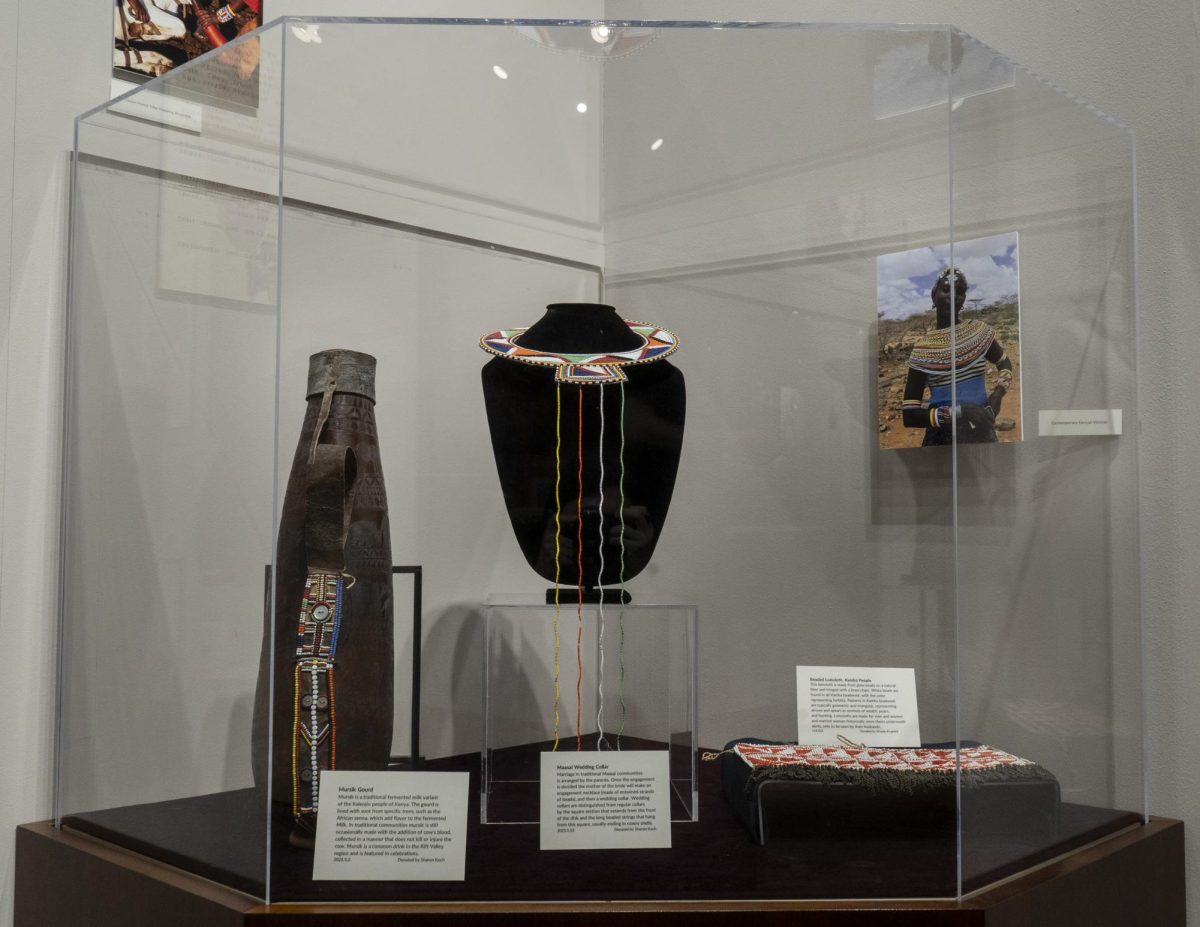
Student curators shared their love for African history and culture during a reception Feb. 2 for Santa Rosa Junior College’s Multicultural Museum’s latest exhibit, “Diaspora In Beads.”
SRJC students Enfys Craft, Julian Cook and Al Haimowitz curated the exhibit, which runs from Jan. 13 to March 12, with support from supervisor Rachel Minor.
Their goal was to analyze the roots of beadwork, and to reveal the complex history of beads and how it remains relevant to African Americans today. The word diaspora, the “movement, migration, or scattering of a people away from an established or ancestral homeland,” was very intentionally used in the naming of this curation. It serves to remind us of the transatlantic slave trade, and hopes to highlight the shifting cultural values beads represent.
Craft has a deep passion for art and culture. They recounted their trip to Kenya as a kid, and expressed the joy they experienced while visiting.
“When I went to Kenya, I was about 10 and my mom was finishing her master’s degree in anthropology. We traveled around Kenya for about a month during the rainy season, and visited a couple of Maasai villages,” Craft said. “It’s really cool to be able to connect that personal experience from when I was a kid to today.”
The first plaque informs the audience that beads are the oldest form of human adornment. The oldest known beads were found in a Moroccan cave made from snail shells, dated roughly 150,000 years ago, according to another plaque.
The exhibit explains that beads can communicate social status, identity and cultural values through symbolism. Cook pointed out that they can serve similar representations today. “A girl with beaded hair is a girl well-loved and taken care of,” Cook said.
As stated by the exhibit, for the Maasai people, color has deep and complex meanings. Each color they use has ties to real-world examples of that color and the meanings related to it.
The Maasai are well known for their jewelry. Their beads, which adorn them from head to toe, each carry deep meanings and symbolism, similar to color.
Many beads used today are made of plastic, and like glass beads before them, plastic beads are being adopted and adapted into multitudes of African cultural languages. “There’s still the status that is displayed through the amount of time that it would take to do your hair, or specifically with the Maasai jewelry, these are still actively being made and worn. You know, these aren’t, like, artifacts or anything,” Cook said.
The exhibit also highlights how as women of the African diaspora struggled to find their way in a changing but hostile America during the 1960s and ’70s, many turned to harmful chemical relaxants to straighten their hair. While this may have helped them fit into white America, the growing Black pride movements of the time encouraged many to reconnect with their African roots, and hair work was one way to do that.
Many Black women found pride and strength in braided and beaded hair, which defined a movement that rejected the European norms thrust upon them. “I don’t think these traditions ever really ended. They just had to morph and be concealed through the transatlantic slave trade,” Cook said.
“Diaspora In Beads“, running from Jan. 13 to March 12 at the SRJC Multicultural Museum, is a brief but rich walk through the history of beadwork throughout Africa.